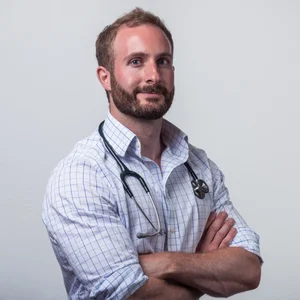
Written by Dr Tom Fisher, GP and founder of Fisher Clinics. Last reviewed 11 November 2026.
Aesthetics has become one of the most common ways for clinicians to broaden their work. For a nurse, doctor, dentist or pharmacist, it offers a chance to use your clinical skills differently, build something of your own, and step a little outside the pressures of your usual role. I did exactly that alongside general practice, and this guide is the honest version of what I wish someone had laid out for me at the start.
It is deliberately a starting point rather than a deep dive. Each area below links to a fuller guide if you want the detail, so you can get the overall picture first and then go as deep as you need.
(This guide focuses on England and reflects the position at the time of writing. Regulation in this area is developing, so check the current position before making decisions.)
Is it right for you? An honest starting point
Before the practicalities, a few honest questions worth sitting with:
Do you actually enjoy the work, or just the idea of it? Aesthetics is a different discipline from most clinical practice. It is elective, appearance-focused, and the consultation skills, managing expectations, saying no to unsuitable patients, are as important as the injecting.
Are you prepared for it to be a business, not just a clinical skill? Marketing, premises, insurance, records, complaints and finances all come with it. The clinical part is often the smallest part of running a clinic.
Can you commit to doing it properly? The safest, most sustainable practitioners treat it as a serious clinical field, with real training, ongoing development and honest record-keeping, not a weekend sideline.
If the answer to those is yes, it can be genuinely rewarding. If you are mainly drawn by the income, go in with your eyes open: it is a competitive, increasingly regulated market, and doing it well takes real investment.
The two broad routes in
How you get started depends on your background.
If you are a registered healthcare professional (doctor, dentist, nurse, midwife or pharmacist), you are on the faster path. Your existing clinical training, anatomy knowledge and professional accountability count for a great deal, and most training providers will let you move fairly directly into injectable training. Many recommend around three years of post-registration clinical experience before starting.
If you come from a non-medical background (for example beauty therapy), the route is longer and more structured, typically progressing through foundation qualifications before injectables, and with important limits on what you can do, particularly around prescribing.
This guide is written mainly with registered healthcare professionals in mind, but the regulatory principles apply to everyone.
Training, and the honest truth about "Level 7"
You will quickly run into the term Level 7, a postgraduate-level diploma in aesthetic medicine, and you will see it described almost everywhere as essential or mandatory. It is worth being clear-eyed about this.
Level 7 is the emerging benchmark for injectable training. It is increasingly what some insurers look for, and it is likely to feature in how competence is evidenced as the sector becomes more regulated. For someone new to aesthetics, and for non-medics especially, it is a sensible and increasingly expected route.
But it is worth knowing two things. First, Level 7 is not currently a legal requirement to perform injectables. The underlying requirement, from your regulator and from insurers, is that you are appropriately trained and competent for what you do. A qualification is one way to evidence that; for experienced clinicians, so are your medical training, your hands-on experience, your foundation aesthetics training and your ongoing CPD. Several providers now offer accelerated routes that let experienced injectors formally evidence competence they already have, rather than starting from scratch.
Second, the training market has a commercial incentive to present the most expensive course as compulsory. That does not make Level 7 a bad idea, it is a genuinely strong qualification, but it does mean you should choose training on its merits and your actual needs, not out of manufactured fear.
The sensible position: train properly, keep evidence of your training and CPD, and make sure whatever you hold satisfies your insurer and matches the risk of what you do. Regulation is moving towards more formal standards, so being able to evidence your competence is what will protect you.
Prescribing: the hurdle to understand early
Botulinum toxin is a prescription-only medicine, so it can only be used following a prescription from an authorised prescriber who has assessed the patient face to face. This shapes how you can practise:
If you are a doctor or dentist, or a nurse or pharmacist with independent prescribing (the V300 for nurses), you can prescribe within your competence.
If you are a nurse or pharmacist without independent prescribing, you cannot prescribe, and will need a genuine, compliant prescribing relationship with someone who can.
This is one of the most misunderstood areas in aesthetics, and getting it wrong carries real risk. It is worth understanding properly before you start. My separate guide sets out who can prescribe and who can administer, and how the two differ.
The regulatory picture: CQC and the coming licensing scheme
Two regulatory questions matter from the outset.
Do you need CQC registration? For purely cosmetic toxin and filler, generally not. But using the same treatments for a medical condition, or offering certain other procedures, can bring you within CQC regulation, and getting this wrong is a criminal offence. My separate guide explains the medical-versus-cosmetic distinction that decides it.
The licensing scheme is coming. England is introducing a licensing scheme for non-surgical cosmetic procedures, likely run by local authorities for standard treatments, with the highest-risk work under the CQC. It is not yet in force, but it will affect who can do what and what you will need in place, so it is worth understanding the direction now. My separate guide covers what is proposed and how to prepare.
Insurance: do not assume your existing cover carries over
This catches people out constantly. Your NHS or employer indemnity does not cover private aesthetic work. You will need your own appropriate cover, and there are real subtleties, the difference between claims-made and occurrence-based policies, run-off cover if you ever stop, and making sure every treatment you perform is actually named on the policy.
Sorting proper insurance is not optional, and it is required by your regulator, by CQC registration where it applies, and by the coming licensing scheme. My separate guide explains what you actually need and the gaps that catch people out.
Setting up: the practical side
The clinical side is only half of it. Getting a clinic actually running means sorting premises, a way for people to find and book you, a way to take payment, and the kit and stock to treat safely. Here is how I approached each, and what I would tell someone starting out.
Premises
You do not need a grand clinic to begin, and I would argue you should not have one. I rent a small three-room space that forms part of a larger block, and I share it with my wife, who runs her own psychology practice from the same rooms. Sharing keeps the costs down, which matters enormously when you are only doing a few clinical hours a week to start with. A room you pay for by the session, or share with someone complementary, is a far more sensible first step than committing to a lease on a space you cannot yet fill.
Before you sign for anywhere, settle the regulated-activity question first. I concluded I did not need CQC registration, because the work I do is cosmetic rather than treatment of a medical condition. That decision matters for your premises, because if you plan to carry out work that counts as a regulated activity, the requirements for your premises and your registration become much tighter. It is far easier to sort this out before you commit to a space than after. (My separate guide on CQC registration explains the distinction.)
When you are choosing a room, think about location and parking, privacy and sound-proofing between rooms, hand-washing and clinical-waste arrangements, and whether the space feels clean and professional to a patient walking in. It is worth looking at how other local practitioners have set up, and there are good guides out there on finding and choosing a room if you want to read around it.
Working from home. A lot of practitioners do it, and I understand the appeal: it is the cheapest possible start and there is no commute. Personally I am not a fan, and it is worth being clear-eyed about the downsides. There is the professional image, the blurring of home and work, having patients in your home, and the practical questions around your mortgage or tenancy, your home insurance, privacy and chaperoning. It can work, but go in with your eyes open rather than drifting into it because it is free.
A word on the coming licensing scheme. The premises question is about to get more formal. The licensing scheme being introduced for non-surgical cosmetic procedures in England is expected to require the premises you work from to be licensed, not just you as a practitioner. That does not change what you should do today, but it is a reason to choose a space that could plausibly meet hygiene and safety standards, rather than something makeshift.
Business rates and business insurance. Two things people forget. First, your premises will usually attract business rates from the local council. Many small single-room clinics qualify for small business rate relief, sometimes in full, but it is not automatic: you generally have to register for business rates first and then apply for the relief through the council. It is worth doing, because the saving can be significant. Second, remember that your indemnity cover is not the same as business insurance. You will also want cover for the premises and contents, and public liability, which is separate from the medical malpractice side. (I cover the indemnity side in my separate guide on insurance.)
Website and finding patients
I built my site on Squarespace, and for most people starting out that, or something similar, is perfectly good. You do not need to pay an agency.
The most useful thing I did was look at how other practitioners, both local and further afield, had set up their sites, and in particular how they priced. That gives you a realistic sense of the market before you set your own prices. I started with stock images and added real photos of the clinic later, once there was something to photograph. One thing worth knowing now that was not an option when I started: you can generate your own images with AI, which sidesteps the licensing costs and restrictions that come with stock photo libraries.
Booking and taking payment
I use the booking system that plugs into Squarespace, and it has earned its keep. I set it up with a short intake form that collects brief medical details and, importantly, asks the patient what they are hoping to achieve. When I was new, that question gave me a valuable heads-up so I could think the treatment through before they arrived, and now that I am more experienced it still helps me make sure I have the right stock ready.
After a couple of no-shows early on, I added a £20 booking deposit, redeemable against the cost of treatment or refunded if no treatment goes ahead. It stopped no-shows dead. If you take one piece of advice from this section, it is that: a modest deposit is the single most effective thing I did to protect my time.
For card payments I use Square. It is a small, cheap card reader that uses your phone or iPad for the chip-and-pin step, the fees are low, and it links to the booking system, so the whole thing runs as one piece of software rather than several that do not talk to each other. For someone starting out, having booking, deposits and payment in one joined-up system is worth a lot.
Stock, kit and emergency drugs
A few practical lessons on supplies.
The main one is not to over-order. Products have expiry dates, and it is a false economy to buy in bulk for a discount only to throw stock away. Pharmacies deliver within a couple of days, so there is rarely a reason to hold large amounts. Order to your actual demand and top up as you go.
Mind your storage, too. Some brands of botulinum toxin need to be kept refrigerated, while others are stable at room temperature, so check the requirements for the products you use. If you are storing toxin, the safe approach is a dedicated medical-grade fridge with a temperature logger, so you can show the cold chain was maintained. An ordinary domestic fridge is not really adequate for this.
For toxin and filler, there are several online pharmacies that specialise in supplying aesthetic practitioners. They often offer bulk discounts, but as above, weigh that against the risk of products going out of date. I use Healthxchange and Church Pharmacy. Setting up an account as an appropriate prescriber is relatively straightforward.
Do not forget your emergency drugs. You should have adrenaline for anaphylaxis, and hyaluronidase available in case of a vascular complication with filler. Being set up to recognise and manage a complication is not optional, it is part of practising safely.
For consumables, I use a dressing pack for each treatment, along with the needles and syringes I need, and Clinisept+ antimicrobial cleanser. I order consumables from suppliers such as Medisave. None of this is expensive, but having it organised and to hand is what makes a clinic run smoothly.
It still counts as your medical practice
An easy thing to overlook: your aesthetic work is part of your professional practice, and your regulator expects it to be reflected in your revalidation or continuing professional development, just like any other part of your work.
Nurses must reflect aesthetic practice within NMC revalidation.
Doctors must make sure appraisal covers their whole scope of practice, including private aesthetic work.
Dentists must consider how facial aesthetics fits their GDC Enhanced CPD, bearing in mind the GDC currently treats it as a non-dental activity.
I have written separate guides for each of these, because the detail differs by profession and it is the part people most often under-evidence.
Start good habits from day one
Here is the single most useful piece of practical advice I can give a new aesthetic practitioner: keep good records of your practice from the very beginning.
When you are starting out, it feels unnecessary, you can remember every case, because there are only a handful. But experience, CPD, complications and reflections accumulate fast, and every regulatory thread above, revalidation, insurance, the coming licensing, rewards the practitioner who can show their competence and development rather than assert it. The practitioners who struggle are almost always the ones trying to reconstruct years of practice from memory when a deadline or a query arrives.
Building the habit early, when it is easy, saves you enormously later.
That is one of the reasons I built Aesthetics Logbook: a simple app for logging your treatments and CPD as you work, with space to capture reflections and feedback against each entry too. It quietly builds a record of your case numbers and experience with each procedure, your ongoing training and your reflections, so you can evidence not just that you practise, but that you develop. It is built around how aesthetic clinicians actually practise, and avoids storing direct patient identifiers to support data-minimisation. It does not replace your full clinical record or your regulatory obligations, and you remain responsible for your own confidentiality and UK GDPR obligations. If you are starting out, building this habit now is far easier than reconstructing it later, and you can find it at aestheticslogbook.com.
A realistic word before you leap
Aesthetics can be a genuinely good addition to a clinical career: rewarding work, more autonomy, and a way to build something of your own. But do it properly. Train well, get your prescribing and insurance right, understand the regulatory position, keep honest records, and treat it as the serious clinical field it is.
The practitioners who thrive are not the ones who did the quickest course and started fastest. They are the ones who built solid foundations, kept learning, and could always stand behind their practice. If you are willing to do that, it is well worth considering.
This guide is for general information and reflects the position in England at the time of writing. It is not legal, financial or insurance advice, and the regulation of cosmetic procedures is developing. Always check the current position with the relevant regulators, take advice appropriate to your circumstances, and confirm requirements with your own indemnity provider.